

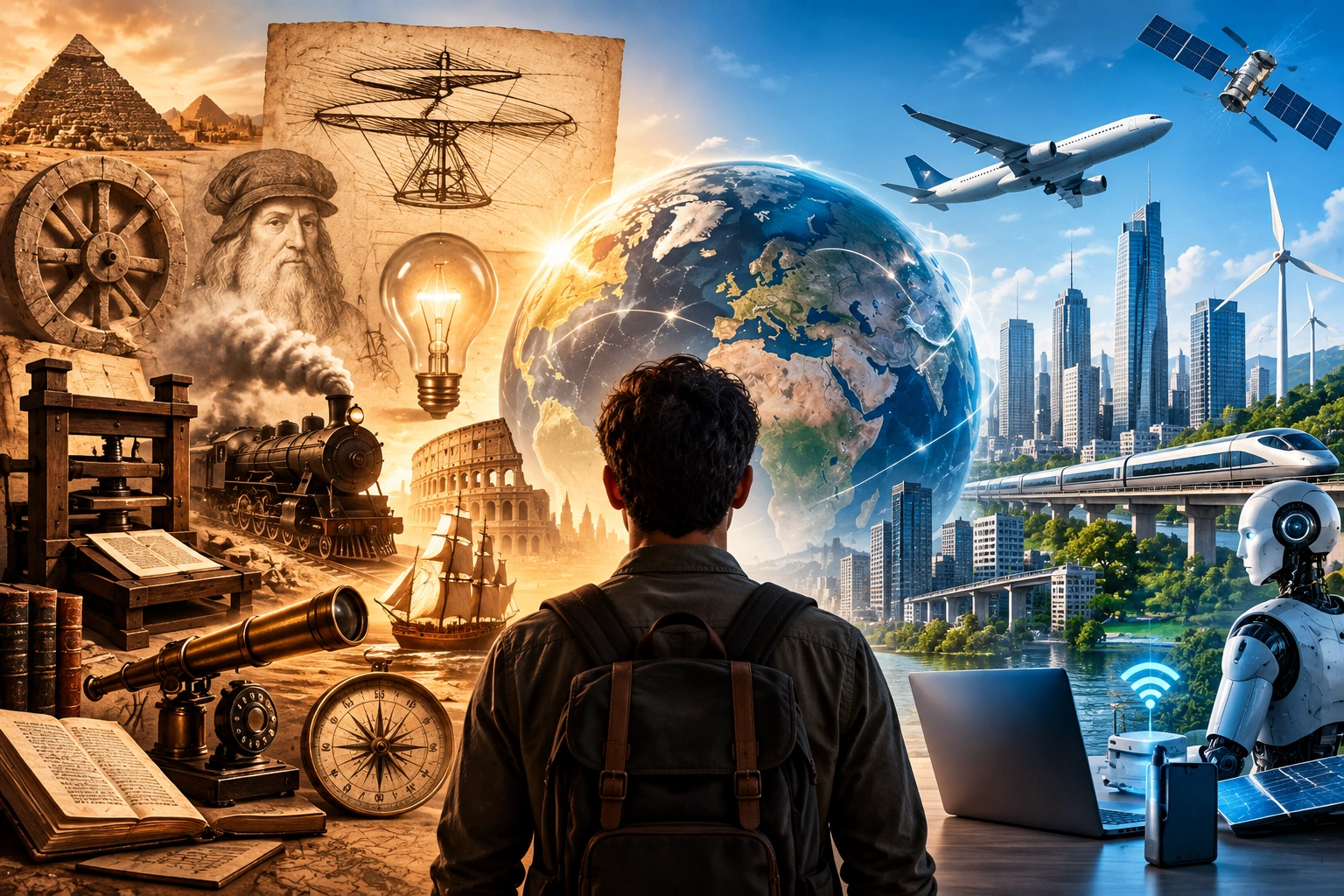
How Historical Inventions Shaped the Modern World
Many technologies that define modern life have roots in inventions and discoveries developed centuries or even thousands of years ago. From writing systems and the wheel to printing technology, mechanical clocks, and early scientific instruments, historical inventions changed how people communicated, traveled, produced goods, and understood the world.
The Wheel and Transportation
The wheel is one of the most influential inventions in human history. Early wheeled technology transformed transportation and mechanical work by making it easier to move heavy materials.
Over time, wheels became part of carts, vehicles, machinery, water systems, and numerous mechanical devices.
Modern cars, trains, bicycles, industrial equipment, and many other technologies depend on principles involving wheels and rotational motion. Although today’s machines are vastly more sophisticated, the basic concept has extremely old origins.
Writing Transformed Human Knowledge
Writing allowed people to record information rather than relying entirely on memory and oral traditions.
Ancient writing systems enabled societies to preserve laws, commercial transactions, religious texts, administrative records, and historical accounts. Written records could be passed between generations and transported across distances.
Modern education, government administration, literature, journalism, and scientific research all depend heavily on written communication.
Paper Made Information More Accessible
Paper technology made recording and transporting information more practical than many earlier writing materials. Its development and spread supported education, administration, literature, and communication.
As paper became more widely used, written information could be produced and stored in increasingly practical ways.
The widespread availability of affordable writing materials later became especially important when printing technology expanded the distribution of books and other written works.
The Printing Press Changed Communication
The development of movable-type printing in Europe during the 15th century, associated particularly with Johannes Gutenberg, dramatically increased the ability to reproduce written material.
Printing made it possible to produce multiple copies of texts more efficiently than manual copying. Books, pamphlets, newspapers, and educational materials could reach broader audiences.
The spread of printed information contributed to changes in education, religion, science, politics, and public discussion. It also helped standardize written languages and preserve knowledge.
The Compass Supported Exploration
Magnetic compass technology provided travelers and sailors with an important navigation tool. Although navigation also depended on stars, maps, landmarks, winds, and other knowledge, the compass offered a reliable directional reference.
Improved navigation supported long-distance maritime travel and contributed to expanding connections between distant regions.
Modern navigation systems now use satellites and digital technology, but the basic need to determine direction remains fundamental.
The Mechanical Clock Changed Timekeeping
Mechanical clocks made it possible to measure time more consistently and precisely than many earlier methods.
Accurate timekeeping became increasingly important for religious activities, commerce, transportation, scientific observation, and later industrial work.
Today, precise clocks are essential for everything from telecommunications and financial systems to transportation schedules and computer networks.
The Steam Engine Powered Industrialization
The development and improvement of steam engines played a major role in the Industrial Revolution. Steam power could be used to operate machinery, pump water, and eventually drive locomotives and ships.
Steam-powered technology changed manufacturing and transportation and contributed to the growth of industrial cities.
Although modern engines and electric systems have replaced many traditional steam applications, industrialization established production methods and infrastructure that continue to influence modern economies.
Electricity Transformed Everyday Life
The development of electrical science and practical electrical technologies fundamentally changed society.
Electric lighting extended productive and social activity beyond daylight hours. Electric motors transformed factories and appliances, while electrical communication technologies made long-distance information exchange increasingly rapid.
Modern homes, hospitals, transportation systems, telecommunications networks, and industries depend heavily on electricity.
The Telephone Revolutionized Communication
The development of the telephone introduced a new way to communicate across long distances through voice.
Instead of waiting for physical messages to travel, people could communicate in near real time. Telephone networks eventually expanded across countries and continents.
Modern smartphones combine voice communication with internet access, photography, computing, navigation, and countless other functions, but their communication capabilities developed from earlier telecommunications technologies.
Vaccination Changed Public Health
The development of vaccination transformed the prevention of infectious diseases. Edward Jenner’s work on smallpox vaccination in the late 18th century became an important milestone in the history of immunization.
Over subsequent centuries, scientific research led to vaccines against numerous diseases. Vaccination has contributed to major improvements in public health and remains an important tool for preventing infectious diseases.
Computers Created the Digital Age
Early calculating machines and developments in mathematics, electronics, and information theory eventually contributed to modern computing.
Computers changed how information is processed, stored, analyzed, and communicated. The development of the internet then connected computers into global networks.
Today, digital technology is integrated into education, medicine, business, entertainment, transportation, manufacturing, and everyday communication.
Inventions Build on Earlier Ideas
A key lesson from technological history is that inventions rarely exist completely independently. New technologies often combine earlier discoveries, improve existing mechanisms, or apply old principles in new ways.
The smartphone, for example, incorporates ideas from telecommunications, computing, photography, batteries, semiconductor technology, and the internet.
This pattern of incremental development continues today.